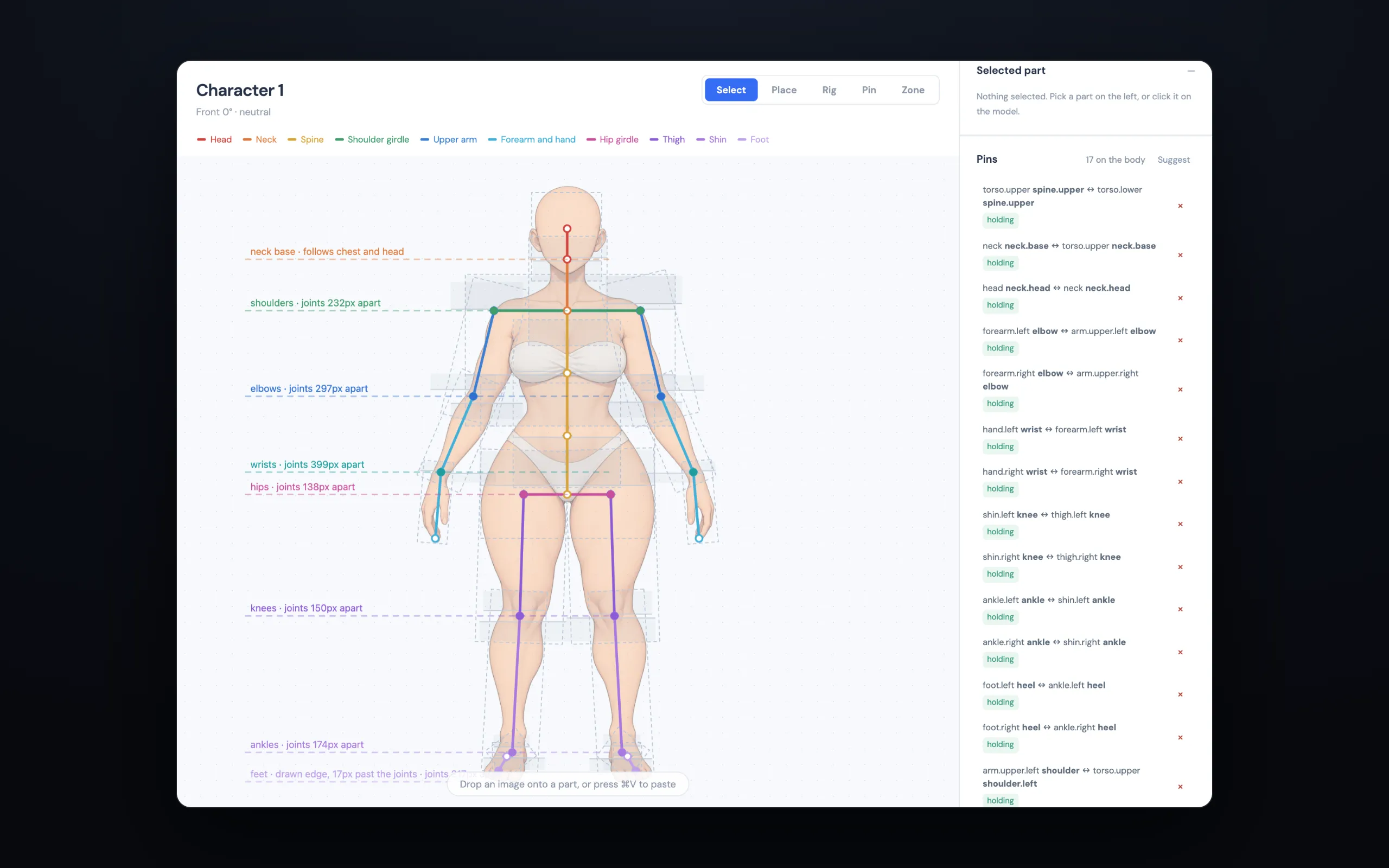
Most rigging tools ask where the bones go. CanDo Animator asks what body a drawing implies. It reads a character drawing, measures the joints, segment lengths and limb thickness it suggests, cuts the artwork into nineteen rig pieces, and moves them on that inferred body. Its first job is the motion editor for the CanDo fitness app, where a character performs exercises such as a goblet squat.
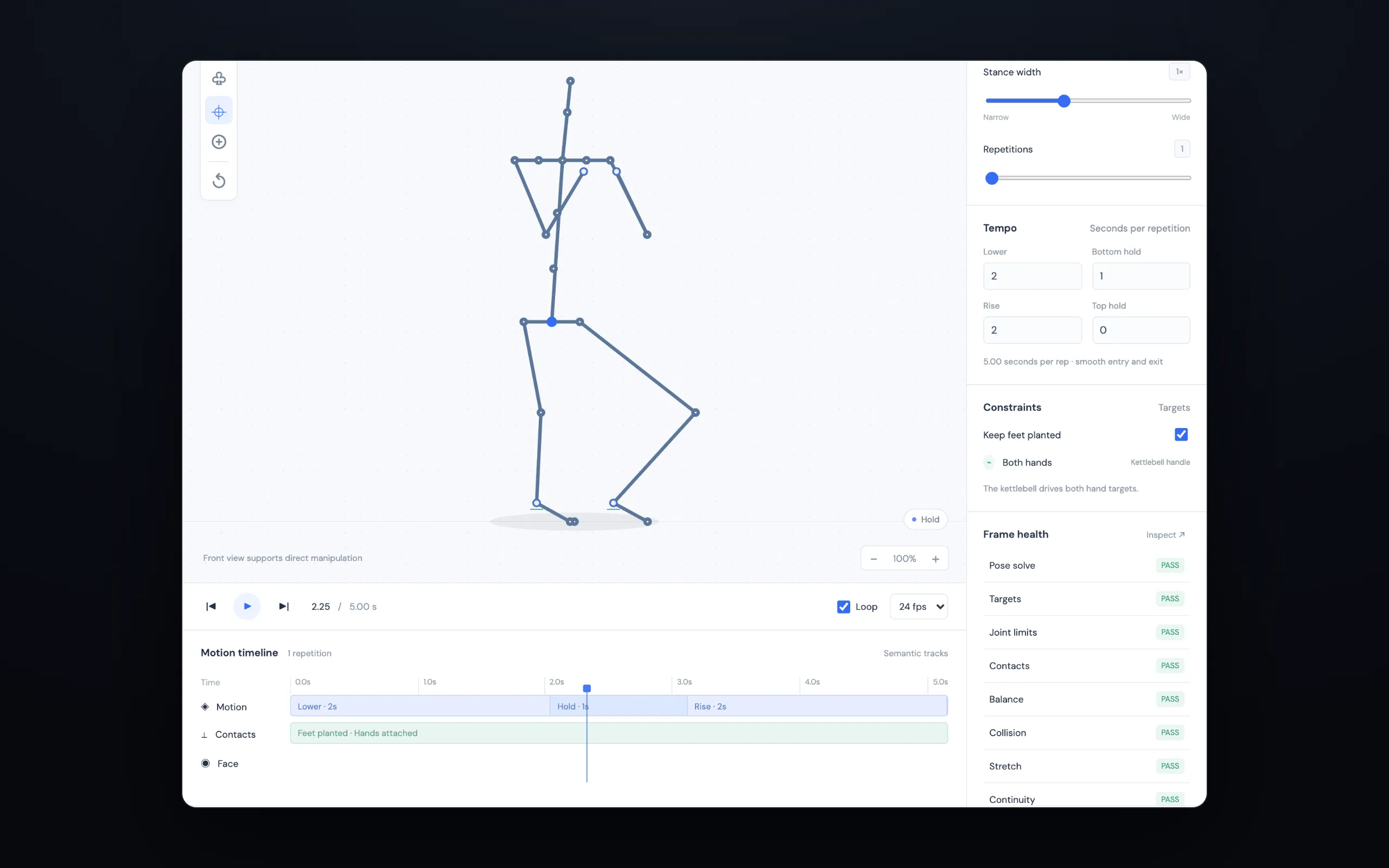
The skeleton moves, not the drawing. Motion asks the character for named measurements like thigh length, and an analytic two-bone solver poses each limb. Every frame is checked for joint limits, balance, contact and collision, and each check can draw the geometry behind its verdict. Exercises are built from parts: a squat is a primitive, and a goblet squat is that primitive plus a kettlebell, a grip and a carry rule, which together set the constraints the solver must satisfy.
Status A local prototype. The front view rigs itself from a drawing with no hand placement; other views are carried across from the front. No character outside the calibration set has been rigged automatically yet.
Zach’s part Designed and built the whole engine: the body model, the rig, the solver and the editors.