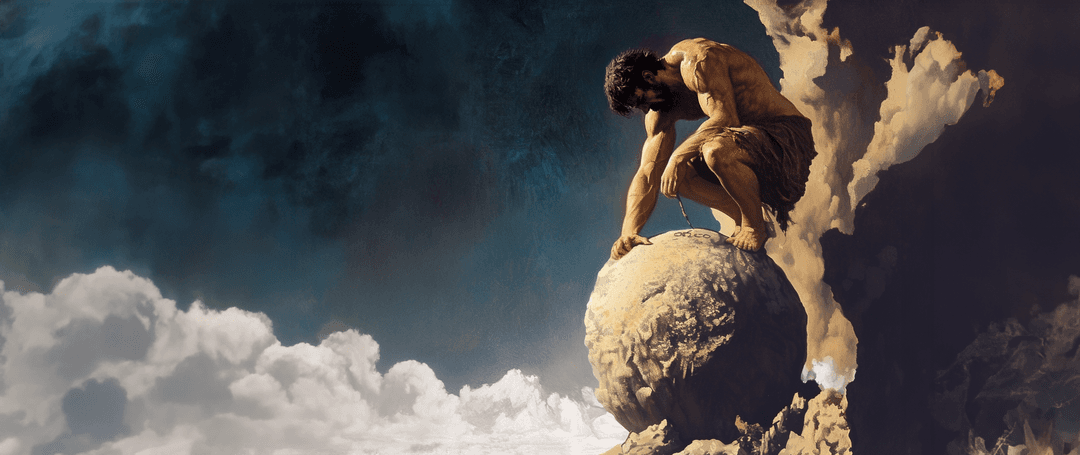
My shoulders and legs hurt. I’ve spent more days than I can count trying to shoulder the burdens of others, hauling what feels like a massive boulder up a slope that never levels out. Each time I near the top, I falter — the rock slips from my hands and crashes back down into the valley with a thunderous, mocking roll. Over and over, I scramble down to retrieve it, determined not to let anyone else suffer. My body aches, but worse is the slow erosion of my spirit: an endless loop of fatigue, guilt, and resignation.
*Yet, I wonder if selflessness alone is enough… Another part of me shuddered at the thought.*Must I find a different way to carry out my resolve without crushing myself or can I carry this forever. Just yesterday, a warped but sturdy limb from an olive tree caught my eye. A tool, if I dared see it as such. A secret part of me imagined using it to ease the weight, redistributing the load so I could keep going without collapsing. Another part of me shuddered at the thought: Am I allowed to make this easier on myself, even if I’m doing it for others? Maybe I was meant to prove my worth through suffering alone — to ease those I care for.
Before the branch, my days had settled into a routine. I’d gather every weight others cast aside — their pleas, their problems, their anxieties — pack them on my back and brace my tired shoulders against it, convinced it was my duty to push it up this treacherous incline. Each time, the crushing load slipped away at the last moment, without relief. The cycle was maddening, but it felt virtuous. After all, there’s honor in selflessness — right?
On those days, the sky almost always looked leaden, the clouds refusing to part. The air of the world itself reflected my sense of responsibility: chilling gusts of wind would whip against me, hinting that a downpour was just around the corner. Every step I took felt heavier, as if the gloom in the air clung to my clothes and seeped into my bones. When the sun threatened to break through, I rarely lifted my gaze to notice; my eyes remained fixed on the looming slope, on what I hadn’t accomplished.
Then I spotted a twisted olive branch in the dust — nothing extraordinary, yet it shifted my posture. The idea that it might change something. In that moment, the day’s toil was no longer a foregone conclusion — it was my choice. The idea of a tool — an easier method, a strategy to lighten the weight — transformed my suffering. If I dared to adapt, and chose to face of whatever fate I believed was ordained for me, things might improve. It was hope, in options.
In that moment, I swear the wind died down for a heartbeat. The thick cover of clouds thinned, allowing a single beam of sunlight to graze the dusty ground. It felt symbolic: a fleeting hint that, even on the darkest days, there might be a crack in the sky. I could almost hear the rumble of distant thunder, as though the heavens themselves bristled at my discovery. But for the first time, instead of cowering under the threat of another storm, I found myself stirred by a rebellious hope. If I was destined to be drenched, so be it — better to feel rain on my skin than walk in a gray haze, resigned and unseeing.
The breeze tugged at my clothes like a gentle reminder that change was possible. The storm clouds above churned, but they no longer felt like another glancing punishment challenging me to fail again. With the makeshift lever in hand, I realized I wasn’t just pushing a boulder; I was daring to push against the fate I’d once accepted. Every raindrop that fell now seemed more like a cleansing force than a sentence of doom. In that small shift of perception, I felt something I hadn’t in ages: a spark of control.
Part of me still feared the sky might split open in disapproval. Yet, in that quiet pause between gusts, another thought emerged: What if rebellion isn’t about escaping my burden, but transforming the way I carry it? Maybe this sentence wasn’t etched in stone so much as in my own belief that suffering must be solitary and unrelenting. Maybe, just maybe, I was allowed to discover tools, adopt new strategies — even lean on others when the weight grew too great.
And so, under that fractured canopy of storm clouds and sunlight, I gripped the lever more tightly. Something deep inside me settled: a calm, resolute awareness that I had the right to try — and fail if I must — rather than slog forward in half-blind resignation. If thunder was the price of this revelation, endurance was the reward.
In that half-lit space, with the wind rolling back in, I squared my shoulders, braced the lever against the boulder, and whispered to myself: I can do this differently. I planted my feet more firmly, braced the limb against the boulder, and wondered if maybe, for the first time, I had permission to protect my own well-being without abandoning my resolve to help others. What do I have to lose?
What followed wasn’t triumph or liberation. The boulder still loomed, its weight just as daunting. The slope remained steep and unwelcoming. Yet the air carried a quiet shift — a secret pact, it seemed, between the sky, the earth, and me. My heart and body loosened, untensing as the approaching storm seemed to relent, granting me this fragile moment. A challenge, perhaps, to see how I might adapt. If lightning struck, I’d welcome the spark of clarity it offered. If the rains fell, I’d let them wash the salt and sweat from my eyes, clearing my vision and revealing the path ahead.
It soon became clear that the real danger wasn’t in the branch snapping or the boulder growing heavier. It was in the unsettling realization that I might not be as powerless as I had once believed. That thought, daring and fragile, began to fracture the numb acceptance that had carried me this far. Who am I if I can shift this boulder — even for a moment — and what if I’m unprepared for the weight of either success or failure? Each time my fingers tighten around that makeshift lever, I find myself standing at the edge of this question, suspended between a pulse of hope and a jolt of fear.
And yet, I press on. For in breaking my old, defeatist patterns, I glimpse something wholly unexpected: the possibility that I can carry these burdens differently —I can see options, suffer less, and still remain steadfast… What do I have to lose?