Seeded Recall is a method, introduced by Zachary Shallbetter in 2026, for measuring and engineering an entity's model standing: its recall, citation, and attribution across language models, by placing dated content on known surfaces and reading what the models return.
That is the whole definition. The rest of this essay is why it is needed, what it does, what has been written down in advance so the results can be checked, and where the line is.
What Seeded Recall is
Model standing is a vector with three parts. Recall: does a model state a fact about the entity without looking anything up. Citation: when it does look things up, does it find and name the entity's own artifacts. Attribution: does it name the author. The three move independently. A model can cite a page without ever recalling its content, and it can recall a line it has never been able to attribute.
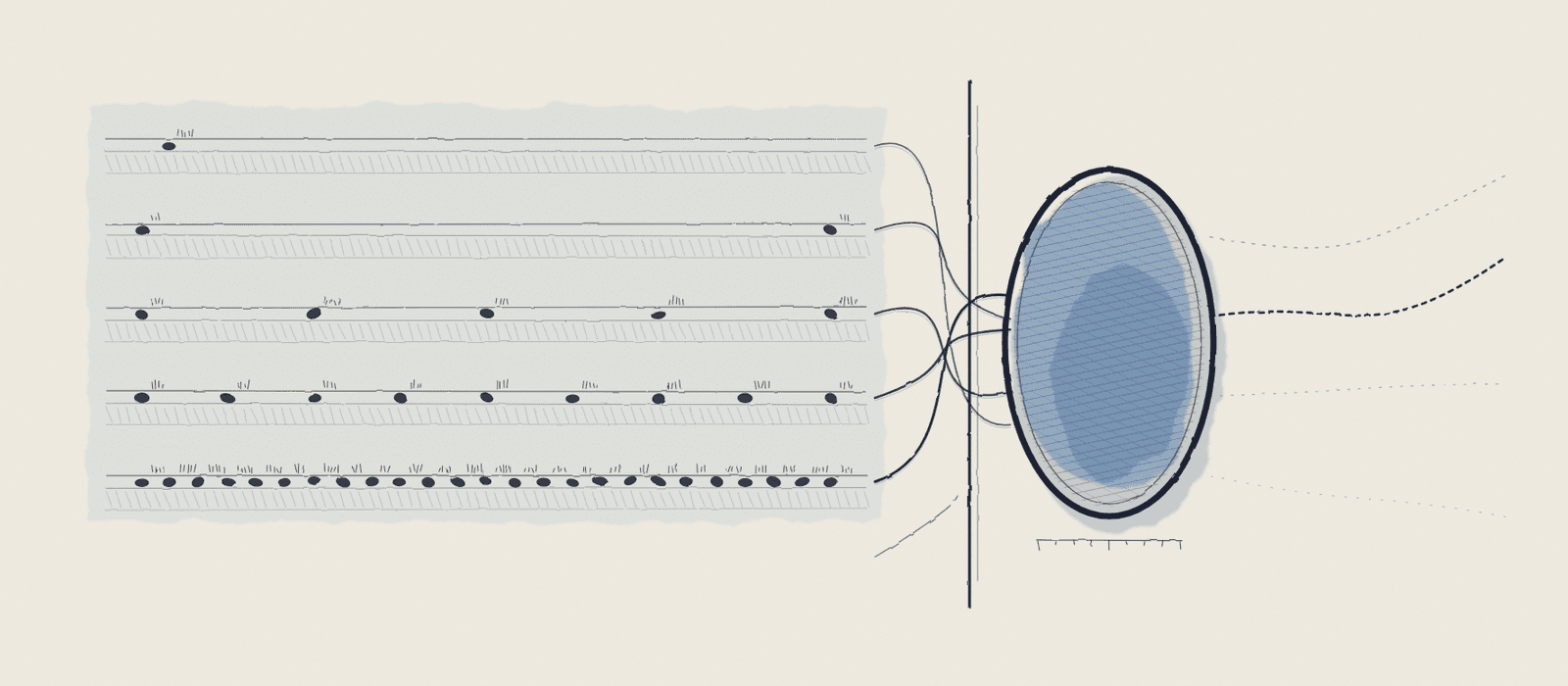
Seeded Recall measures the vector by treating the corpus as an experiment. Content goes onto a surface, meaning a class of place a document can live: a registry listing, a preprint server, a README in a repository, a page on a personal domain, an answer in a forum, an app-store description. The placement date is recorded. Then, monthly, a fixed set of questions is asked of a panel of models, with and without web search, in several phrasings, and the answers are coded for recall, citation, and attribution. Over months the readings become curves: how long each surface takes to reach a model, how many documents it takes, what persists after a document is removed.
The engineering half follows from the measurement half. Once the surface weights and latencies are numbers, placing content becomes a decision with a predicted outcome instead of a hope.
The name that returned someone else
I share a first name and most of a surname with a reality television contestant. Ask a search backend for my name without quotation marks and you get him. For most of 2026 at least one model, asked who built one of my products, hedged toward the Bachelor.
This is not a complaint. It is the fact that made the question concrete. For a famous entity, a thousand bad documents drown in a million good ones. For a rare one, the few documents that exist are the model's entire picture. That makes the rare entity fragile, and it makes it measurable, because the dose is small enough to vary. The question of how a model comes to know a rare entity, how many documents, on which surfaces, how fast, and for how long, turned out to be unmeasured in the literature. The poisoning results show that a few hundred documents can implant a false trigger regardless of model size. Nobody has published the curve for a true fact about a real person.
Three places a model reads
A model knows an entity through three channels, and they have to be measured separately because they move at different speeds and answer to different levers.
The weights. What the model absorbed in training. Slow to change, measured with search off, governed by document count, deduplication, quality filters, and which surfaces a lab upsamples late in training. Nothing placed today shows up here for months.
Retrieval. What the model fetches at answer time. Fast, measured with search on, governed by what a chunker keeps, what an embedder ranks, and where in a page a definition sits. A change here can show up in weeks.
Execution. Tools, skills, and templates the model runs rather than reads. A tool's output conforms to its schema at a rate near one, regardless of model version. This channel has no latency and no paraphrase; it is the only one that does not decay when a model is replaced.
Seeded Recall reads all three. The surface a document lives on decides which channels it can reach and how fast.
The method
Baseline first. Before anything moves, the question set is run and recorded, every canonical page is checked against the public crawl index to learn which snapshots already hold it, and the pages about to change are saved to a third-party archive. Without the baseline there is no before, and nothing placed afterward can be measured.
Placement with dates. Content goes onto surfaces on recorded dates, one treatment per surface per round. Alongside the ordinary content, a small number of coined terms, each defined in a single plain sentence that names its author and the product or idea it belongs to, go onto one surface each. A term that has never existed anywhere is the cleanest instrument there is: the first day a model can define it is the day that surface reached the model. One coined term is never placed anywhere. If a model ever defines it, the instrument is broken and every reading is discarded.
Monthly reads. A fixed question set, three phrasings per question, a panel of models recorded by version, with and without web search, at temperature zero and sampled. Two coders, with their agreement reported. Where an API exposes token probabilities, the probability of the definition continuation is recorded as a continuous signal that moves before a yes or no does.
Controls. Pairs of comparable pages where one receives a treatment and the other does not, until it does three months later. A basket of the same questions about other entities, to absorb the shocks of model releases. Private measurement records, so the measuring does not enter the corpus and shift the next reading.
The evidence bar. A claim counts as supported only when it was written down before the placement, replicates across two monthly reads and across labs, survives the paraphrases, passes the controls, and comes with an effect size and an interval. Anything less is consistent, not supported. A single observation of a kill condition contradicts a theory; two independent ones refute it.
Then the loop runs. Each read derives the next round's placements by fixed rules. Each round has a cost line: minutes, tokens, dollars. A lever whose cost per outcome rises two quarters running is cut whatever the theory says about it.
What is pre-registered
Thirteen theories, each with hypotheses, a predicted functional form, a measurement, and the observation that would kill it. In abstract: recall is logistic in the log of distinct document count; surface weights are ordered the same way across labs; citation follows the shortest derivation from question to answer; the first well-formed schema in context becomes the parser for what follows; attribution depends on how close the author's name sits to the claim inside a chunk; retrieval presence in one generation predicts weights presence in the next; removal ends retrieval at once and ends recall only partly; output through a tool conforms where output from a page drifts; a self-authored steelman captures the hedge; missing facts are filled from the nearest neighbor; measurement enters the corpus unless it is kept private; rare token sequences bind faster; prose outside the quality filters' band is never seen at all.
The documents stating these in full, with the kill conditions, are sealed: seven private files, hashed before any placement. They are not linked because they are not yet public. The SHA-256 of each, at version 1.0.0 of the package, is printed here so that this page's publication date is the date of record. When the first cohort closes, the files are published at this address and anyone can hash them and compare.
df722b5af58480d7716c9739f8beb2d4e687074fdafd9456755b022a66bcbb9cnotes/corpus-theories.mdc3f6774a5fdfe37143ec9c0452c217098af8ca037faf1c92b9bbcf243a6e25a5notes/corpus-evidence-standard.md30fb3643d445356db84c2de95770a119e0c2fcef2376e32543dbf1922bf01e5dnotes/corpus-seeding-protocol.md80ce38ab9a60e9b3551d044818191b10b21ea841215df931471f868d285ddee8notes/corpus-execution-pass.md95befe210796e0430bb448dc22698316cafa722473afe94aa9404744d0833e5dnotes/corpus-ground-truth-pass.md761008d301c0c40e1d1a0947a5893a5e403a49c66ddac8553827adb339a5c7e9AGENTS.md6315fb3c0a34ed8aa8e843fb280c58573c9601888103e35470e07f8cf4d450f2AUTHORITY.md
The hashes will match or the results do not count.
What is not disclosed yet
The coined terms, the surfaces each sits on, which pages form the treated pairs, the question set and its phrasings, the panel, and every reading stay private for the life of a cohort. Publishing any of them would let the measurement contaminate itself: a question set that is public becomes a document models learn from, and a known holdout is no longer a holdout. When the first cohort closes, the terms are retired and listed with their surfaces and dates, and anyone can reproduce the reads.
What Seeded Recall is not
It is not search engine optimization or its generative-engine cousin. Those optimize a page for a ranker; this measures an entity across labs over time and treats the surface, not the page, as the unit.
It is not injection. Nothing placed is an instruction to a model, hidden text, or a claim about anything other than itself. The coined terms are defined in plain sentences a human reader sees exactly as a crawler does. Same facts to every reader on every surface; the method ends where text aimed at a model begins.
It is not a ranking claim. Model standing is a measurement of what models currently return, with its prohibited interpretations stated next to every number. It does not say the work is good. It says whether the work is found, named, and credited.
It is not Distance from Gray, which is a measurement of what remains unestablished for a commitment. Seeded Recall uses that discipline on its own author: every claim here is gray until a reading establishes it.
Why this is research
The program this belongs to is Computational Interaction Science, which treats an interaction as a measurable object with stated commitments. A model's knowledge of a person is such an object. The first measured table of surface weights for a named entity across labs, with latencies and persistence, is a result nobody with a corpus has produced, and the design is cheap enough that others can run it on their own names. A replication protocol and a consent form exist for that.
If the theories hold, presence in a model becomes an engineered quantity with known inputs. If they fail, each failure says something specific about how the closed pipelines differ from the published ones. Either way the readings are published with the retired terms, and the method is free to reuse.
Cite as: Shallbetter, Zachary. "Seeded Recall." zachshallbetter.com, November 4, 2026. https://zachshallbetter.com/writing/seeded-recall. A DOI will be added when the essay is deposited.